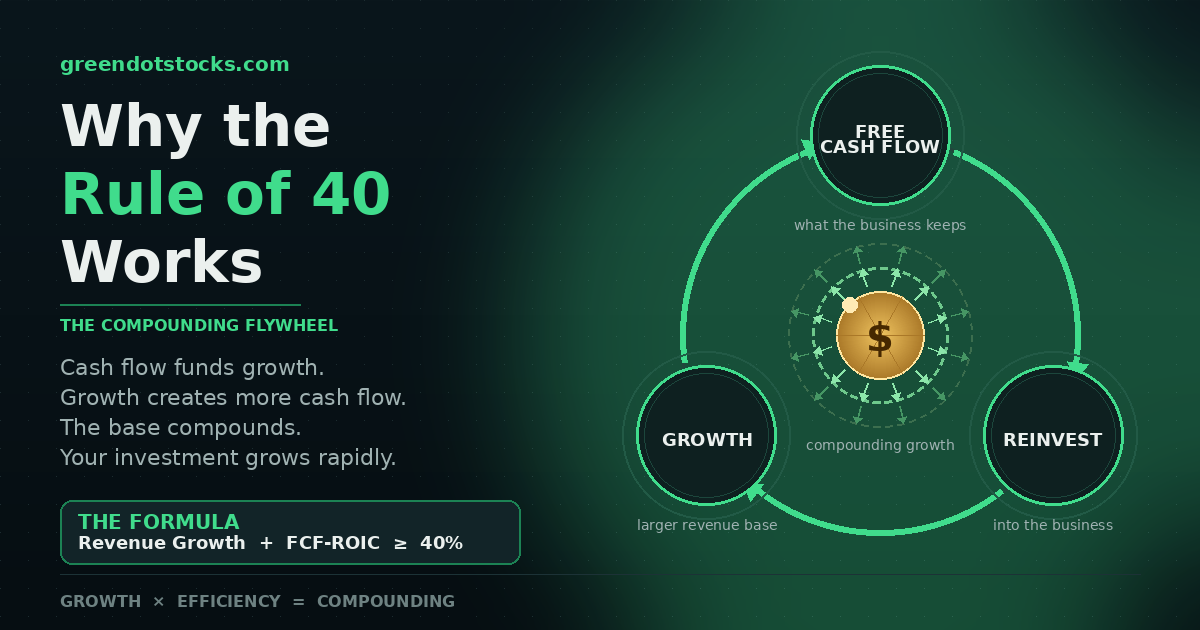
The Rule of 40 adds revenue growth to profitability. On GreenDot Stocks, it uses revenue growth plus FCF-ROIC to spot businesses that turn capital into free cash flow and still have room to compound.
Investors love complicated stories because complicated stories feel intelligent. They come with TAM charts, product maps, AI narratives, and enough jargon to make almost any mediocre business sound important.
But when you strip all of that away, most long-term winners still come back to the same two questions.
First, does the company turn capital into real free cash flow efficiently?
Second, does it still have enough growth left to reinvest that cash and keep expanding?
The Rule of 40 matters because it wraps both questions into one quick number.
How to Calculate the Rule of 40
In its basic form, Rule of 40 = growth rate + profitability metric. In software and growth investing, that threshold is often used as a rough sign that the business has found a healthy balance between expansion and financial discipline.
On GreenDot Stocks, the formula uses revenue growth plus FCF-ROIC.
That is a slightly tougher and more useful version than a simple margin check.
Revenue growth tells you whether the company is still moving forward. FCF-ROIC tells you whether the business is turning invested capital into free cash flow efficiently. Put the two together and you get a shorthand for whether the company is both productive today and capable of getting bigger tomorrow.
That is why a score above 40% matters. It does not prove a stock is cheap. It does not guarantee a great investment. But it is often a strong sign that the business itself is doing something right.
Why Free Cash Flow ROI Matters So Much
Free cash flow is the part that ultimately matters because it is what the business actually gets to keep.
Accounting earnings can flatter a story. Adjusted metrics can flatter a story even more. Free cash flow is harder to fake for long. It is the money left after the business pays for the operating costs and capital spending needed to keep running.
That is why high FCF-ROIC is so powerful. It tells you the company is not just growing for growth's sake. It is taking capital and turning it into real cash efficiently. In practical terms, that usually means the underlying business model has some combination of pricing power, operating leverage, good management, or a real competitive edge.
If a company cannot generate cash efficiently, then even fast growth can become a treadmill. It keeps running harder, but the shareholder never gets much richer.
That is usually the problem with revenue growth on its own. If the company is not producing real free cash flow or strong returns on capital, that growth is often being financed from outside the business through debt, dilutive equity issuance, or both. Revenue can keep climbing, but the economics per share do not improve the way investors think they will.
Why Growth Is The Other Half Of The Equation
A company can be highly cash-generative and still be a mediocre stock if it has nowhere meaningful to reinvest.
That can still describe a good business. It may return cash through dividends and buybacks, and those returns can be perfectly respectable. But the market usually assigns lower valuation multiples to slower-growth companies, so the upside tends to come in steadier, smaller increments rather than the kind of share appreciation that creates doubles or triples.
That is why the growth side matters so much. A high growth rate suggests the company still has room to deploy capital into more sales, more customers, and more future cash flow. It is evidence that the machine is not finished yet.
That is why you need both. Growth without FCF-ROIC can be fragile because it may be funded by outside capital. FCF-ROIC without growth can be solid but less explosive because the reinvestment runway is shorter and the market is less willing to pay up for it.
This is where the Rule of 40 works as a shorthand for compounding.
Most people understand compound interest. You put money into an account, it earns interest, that interest gets added back to the balance, and then the bigger balance earns even more interest. Over time, the curve bends upward because the base keeps getting larger.
A great growth business can work the same way.
The company generates free cash flow. Management reinvests that cash into projects that produce more revenue. That larger revenue base throws off more free cash flow. Then the company reinvests again. If the business can keep that loop going for three to five years, the effect on the underlying economics can be dramatic.
That is the flywheel investors are really hunting for.
| Rule of 40 component | What it tells you |
|---|---|
| Revenue growth | The business still has room to expand |
| FCF-ROIC | The business converts capital into real cash efficiently |
| High combined score | The company may be compounding, not just growing |
Why This Can Lead To Big Stock Winners
The stocks that double or triple over a three-to-five-year period usually do not get there because investors suddenly become more imaginative. They get there because the business keeps compounding underneath the surface.
When a company can grow fast and generate cash efficiently, it gives itself more ways to win. It can self-fund expansion. It can avoid constant dilution. It can survive rough markets better than weaker peers. And if the market starts to recognize that quality, the valuation multiple can rise at the same time the business itself is getting bigger.
That is how outsized returns happen. You do not just get a better narrative. You get a larger earnings and cash flow base, plus a market that may be willing to pay more for each dollar of it.
Why The Rule Of 40 Is Only A Shorthand
None of this means the Rule of 40 should be used in isolation.
It does not tell you whether the stock is overvalued. It does not tell you whether management is promotional. It does not tell you whether the moat is real, whether the balance sheet is stretched, or whether the industry is about to get more competitive.
What it does do is point you quickly toward businesses worth deeper attention.
That is why the metric is useful. It is a fast filter for one of the most important combinations in investing: a company that can produce real cash today and reinvest it into more growth tomorrow.
If you want to find businesses where that compounding flywheel may already be turning, take a look at the GreenDot Stocks screener.