Every dollar of revenue looks identical on an income statement. For a long-term investor, that is a dangerous illusion.
One dollar has to be hunted down again next quarter. Another shows up next week, next month, and next year with barely any extra selling effort. Both count as revenue. Only one behaves like the raw material of compounding.
The rule of thumb is simple: do individual customers pay the company on a routine, predictably recurring basis, generally weekly or monthly? If yes, durability rises. If no, the business may still be attractive, but it does not deserve the same premium.
The GreenDot Stocks Test
As Investopedia's recurring revenue overview explains, recurring revenue is sales a business can count on receiving regularly with a relatively high degree of certainty. GreenDot Stocks applies a stricter behavioral version of that idea.
The question is not just whether revenue repeats in an accounting sense. The question is whether the customer relationship itself repeats with very little friction. Does the service auto-renew? Does the product need replenishment? Does the company sit in the middle of something the customer is already going to do every week or every month?
A business can have repeat customers without having recurring revenue. If management still has to re-sell the customer every quarter, re-win the budget, or wait for a project to restart, the revenue is repeatable at best. GreenDot Stocks is looking for revenue that feels closer to default behavior.
Labels Can Mislead
Management teams know investors love the word recurring, so they use it liberally. Support work, professional services, ad budgets from repeat customers, and even ordinary reorders can all be framed that way.
GreenDot Stocks cares less about vocabulary and more about customer behavior. If a customer can pause spending without much pain, if each period begins with a fresh buying decision, or if revenue depends heavily on volatile end-market demand, then the business is not truly recurring in the way long-term investors should care about.
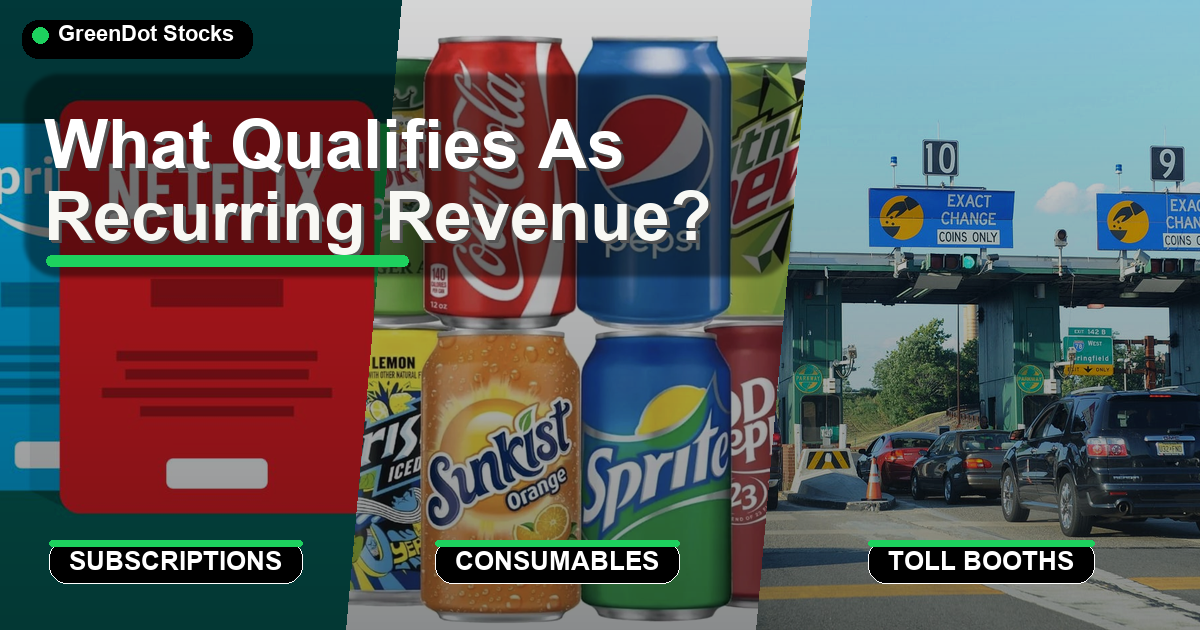
The Cleanest Bucket: Subscriptions And Service Contracts
When customers pay monthly or annually for software, data, security, infrastructure, or another mission-critical service, future revenue becomes easier to see. The company is no longer starting from zero each quarter. It is starting from an installed base.
Retention is a much easier economic problem than constant reacquisition. A company with strong retention can spend less energy replacing lost revenue and more energy expanding accounts, raising prices carefully, and building new products.
The best subscription businesses also benefit from switching costs. Once workflows, employee training, data, and internal processes are built around a product, canceling it becomes disruptive. The customer is not buying a nice-to-have. The customer is maintaining part of the operating system of the business.
Autodesk (ADSK) is a clear GreenDot Stocks example. Designers, architects, and engineers keep paying because the tools sit in the middle of daily work, collaboration, and file compatibility. That is what real recurring revenue looks like.
That is why investors spend so much time on renewal rates, deferred revenue, backlog, and net retention in software businesses: they help answer how much of next year's revenue is already spoken for.
The Contract-Free Version: Consumables
Recurring revenue does not always require a signed contract.
Some businesses create recurrence because their products get used up quickly and must be bought again with minimal deliberation. Soda, coffee pods, razor blades, pet food, household basics, and many medical supplies fit this pattern.
GreenDot Stocks is willing to treat many consumable businesses as recurring even though the customer is not technically on a subscription. The behavioral pattern still repeats on a tight cycle.
PepsiCo notes on its investor site that its products are enjoyed over a billion times a day. That is not recurring revenue in a legal-contract sense. It is recurring in a consumer-behavior sense.
For GreenDot Stocks, consumables usually qualify when three things are true: the product has a short useful life, customers replenish it frequently, and the purchase is habitual rather than heavily debated.
This also explains what does not qualify. Durable goods rarely pass the test. A customer may love a refrigerator, mattress, treadmill, or sofa, but that does not create recurring revenue if the purchase only happens every few years. Great product. Bad recurrence.
The Toll-Booth Model
Marketplaces, payment rails, and other toll-booth businesses earn a small fee every time economic activity passes through their network. The customer may not think of the payment as a subscription, yet the company still gets paid repeatedly because it sits in the middle of a routine action.
In the strongest cases, this model combines habitual use with network effects, making the service more useful, more embedded, and harder to displace as more customers, merchants, or billers join.
Mastercard (MA) and Visa (V) are probably the purest version of this model. They do not need to persuade consumers to buy a subscription every month. They collect fees every time cardholders tap, swipe, or click through their networks, which turns everyday commerce into a steady stream of small tolls.
That is what makes the model so powerful. Mastercard's filings show a network with 3.7 billion cards and roughly 175 billion switched transactions in 2025, while Visa's filings describe a system handling more than 829 million transactions a day across more than 200 countries. The model is still transactional, but the underlying behavior is so routine and so deeply embedded that it behaves like elite recurring revenue.
Repeat Usage Is Not Enough
A business can have lots of repeat transactions and still fail the GreenDot Stocks test.
Take advertising platforms. A brand may spend with the same platform for years. That does not make the revenue truly recurring if budgets can be shut off quickly during a slowdown or redirected next quarter.
Pinterest (PINS) is a useful gray-area example. Advertisers often return because the platform performs well, but the spend is still tied to campaign budgets rather than to a hard subscription or an unavoidable household payment.
Airbnb (ABNB) is another cleaner example. Guests and hosts may come back often, but the revenue is still tied to individual bookings rather than to subscriptions or long-term contracts.
That means the business can enjoy strong repeat usage while still seeing revenue swing with travel demand, seasonality, and the economy. The activity repeats. The predictability is softer.
That is the core distinction GreenDot Stocks is trying to capture. Recurring revenue is not just about seeing the same customer again. It is about how little has to go right for the revenue to come back.
Why Long-Term Investors Care
When a meaningful piece of next quarter is already visible, management can plan better. It can hire with more confidence, invest in product development, and manage costs without constantly wondering whether sales will reset to zero. That stability tends to show up in better execution over time.
It also improves the odds of attractive cash economics. As GreenDot Stocks argues in Why Free Cash Flow Is Better Than Earnings, free cash flow is the cash left after a company supports operations and capital assets. That is the money that funds reinvestment, buybacks, dividends, debt reduction, and resilience during a downturn.
Stable revenue does not automatically create strong free cash flow, and some recurring businesses still deserve low valuations. But recurring revenue usually gives management a better base to build on because the company is spending less time replacing disappearing sales and more time compounding an existing customer base.
That is also why the market often pays a premium for recurrence. Forecasts are more reliable, revenue shocks are less common, and customer lifetime value is easier to estimate.
Put differently, recurring revenue does not guarantee a great investment. It simply gives a business a much better starting position than a model that must constantly re-win the customer from scratch.
| Business model | GreenDot Stocks read | Why |
|---|---|---|
| Auto-renew subscriptions and service contracts | Strongly recurring | Customers keep paying until they actively cancel |
| Consumables with short replenishment cycles | Usually recurring | Habitual replacement creates predictable repeat buying |
| Toll-booth payments and embedded marketplaces | Often recurring | Daily usage can be recurring-like when contracts and workflows are sticky |
| Ad budgets, project work, and volume-sensitive transaction models | Low recurrence | Revenue may repeat, but it still depends on fresh decisions or volatile activity |
The easiest way to think about the whole idea is this: GreenDot Stocks is not just looking for revenue that comes back. It is looking for revenue that comes back on its own.
That sounds like a subtle wording change. For long-term investing, it is enormous. If you want to see how that lens gets applied across real companies, take a look at the GreenDot Stocks screener.
References
- Investopedia: Recurring Revenue
- Investopedia: Switching Costs
- Investopedia: Network Effect
- PepsiCo Investor Relations
- Adobe Investor Relations
- Adobe Financial Documents
- SEC EDGAR Company Search: Mastercard 10-K Filings
- SEC EDGAR Company Search: Visa 10-K Filings
- SEC EDGAR Company Search: Adobe 10-K Filings
- SEC EDGAR Company Search: Procter & Gamble 10-K Filings