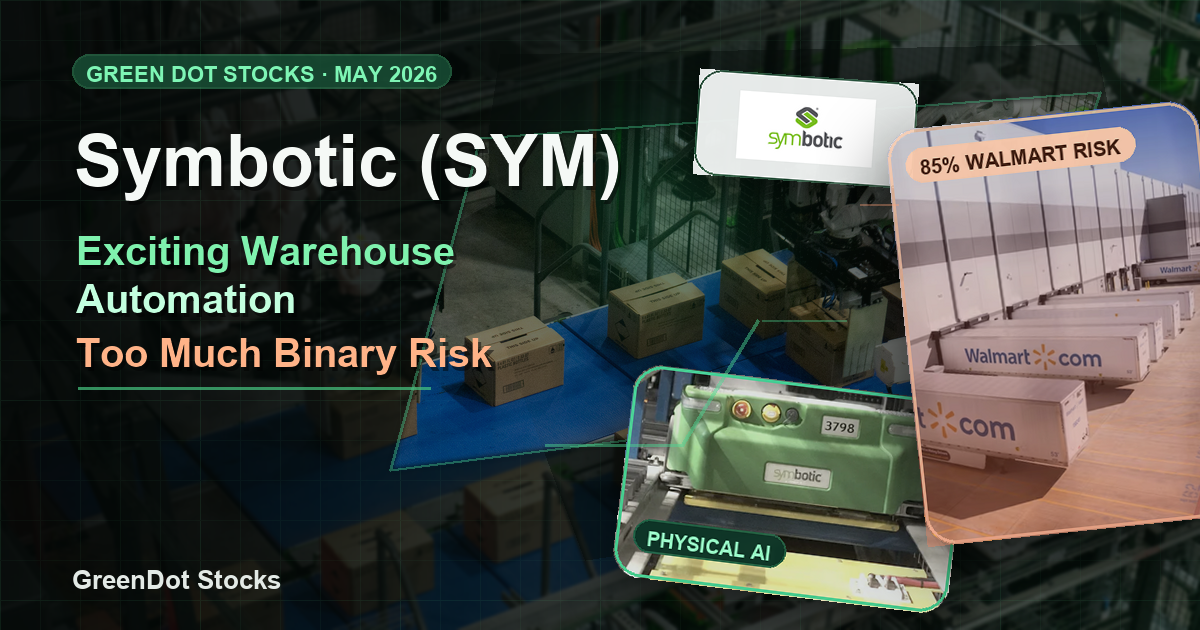
Symbotic (SYM) is one of those companies that can be genuinely exciting to study and still feel wrong to own. The business sits in a valuable part of the economy, the warehouse, where labor costs, throughput, inventory density, and delivery speed all collide. It also sits right at the intersection of robotics, software, and physical AI, which gives the story a lot of investment demand appeal. On GreenDot Stocks, Symbotic still screens as a "green-dot" (high quality) business, and the current screen shows the stock trading in the low $50s against a blended price target of $60.36, implying roughly 15% upside.
That sounds attractive at first glance. But this looks like one of those cases where the business quality is easier to admire than the stock is to own. If you dislike binary-event risk, Symbotic has too many pressure points packed into one name.
The Business Is Easy To Admire
Symbotic is not selling a novelty robot. It is building end-to-end warehouse automation systems that receive goods, break pallets into cases, store those cases densely, retrieve them rapidly, and rebuild outbound pallets in the right order for stores and distribution partners. On Symbotic's website, the company says its systems can reduce warehouse labor costs by 60% to 80%, improve throughput by 9x, and deliver 99.99%+ accuracy.
That pitch is compelling because warehouses are still full of friction. Cases arrive in bulk, move too many times, get stored inefficiently, and often leave the building through labor-heavy processes that waste time and money. Symbotic is trying to turn that whole environment into a coordinated machine. In the 2025 annual report, the company describes bots moving cases through a dense storage structure, software choosing what should move and when, and outbound robotic systems building mixed-SKU pallets in a store-friendly sequence.
That is the part of the story that deserves real credit. This is not just robotics hardware scattered around a warehouse. It is software-directed automation at scale. The warehouse becomes something closer to an operating system for physical goods.
The opportunity is also larger than it first appears. Symbotic's 2025 annual report lays out a $144 billion primary market in U.S. warehouses across grocery, food distribution, consumer packaged goods, and apparel, plus another $126 billion in secondary verticals and $52 billion in additional categories over time. The company is also pushing beyond its core distribution-center footprint into micro-fulfillment and local pickup automation, which broadens the story beyond a single product line.
This is the kind of company that makes intuitive sense once you understand it. Retailers want denser storage, fewer picking errors, faster turns, better trailer utilization, and lower labor dependence. Symbotic is aiming directly at that pain.
The Operating Story Looks Real
The recent numbers give the narrative more credibility. In the first-quarter fiscal 2026 earnings release, revenue rose 29% year over year to $630 million and adjusted EBITDA jumped to $67 million from $18 million a year earlier. In the second-quarter release, revenue climbed another 23% to $676 million, net income turned positive at $9 million, and adjusted EBITDA more than doubled to $78 million. Management also said total systems in deployment rose to 70.
The backlog is large enough to take seriously as well. In the March 2026 10-Q, Symbotic reported $22.7 billion of remaining performance obligations. The same filing said about 14% of that amount is expected to be recognized over the next 12 months. That does not make revenue smooth, but it does show the company is not surviving on a thin order book.
The balance sheet looks strong on the surface. Cash and cash equivalents reached about $2.0 billion by the end of the second quarter, and Reuters lists the company with no total debt in its 2025 annual balance-sheet data. The GreenDot Stocks screen also likes the combination of growth and efficiency, with current-year sales growth at 24.0%, next-year sales growth at 27.0%, Rule of 40 readings above 139%, and FCF-ROIC above 115%.
That is the good-news side of the debate. The company appears to be building something real, not just selling a future vision.
The Risk Screen Is Where The Story Breaks Down
The problem is that the stock comes with several event risks that are too concentrated for many investors.
The first one is obvious and, in my view, the biggest. Symbotic is still deeply tied to Walmart. In that March 2026 10-Q, this one customer accounted for about 85% of total revenue. That is not normal customer concentration. If Walmart slows deployments, changes priorities, pushes harder on economics, or decides Symbotic is not meeting expectations, the revenue model, backlog story, and valuation narrative all take a hit at once.
The concentration risk is even worse than a simple revenue figure suggests because Walmart is woven into the structure of the business. The annual report and proxy statement describe board-observer rights for Walmart, change-of-control restrictions, notice requirements around certain strategic transactions, and limitations on the company's ability to sell or license products in certain situations. Under the 2025 Walmart agreement, there are also quantitative restrictions around sales to third parties. That is a lot of influence concentrated in one customer relationship.
The second event risk is execution and product reliability. In the second quarter of fiscal 2026, Symbotic recorded an additional $34.3 million liability for a targeted component replacement program after monitoring and testing identified performance trends that required further evaluation, according to that 10-Q. A business that sells complex automation into mission-critical facilities has very little room for quality surprises. If that kind of issue spreads across a broader installed base, the financial hit is one problem and the confidence hit is another, potentially larger one.
The third risk is that backlog can look safer than it really is. A $22.7 billion obligation base sounds comforting, but these are long-duration, milestone-heavy contracts tied to system performance, installation timing, and customer pacing. The company itself says remaining performance obligations are affected by terminations, scope changes, periodic revalidation, inflation adjustments, and project timing. That means the backlog is large, but not immune to disappointment. A delay in deployment, customer acceptance, or commercialization timing can easily spill into a weak quarter and reset sentiment fast.
The fourth risk is legal and control-related. Symbotic is still dealing with securities litigation tied to revenue recognition, deployment times, financial results, and internal controls. Even if the company eventually prevails, those issues keep a risk premium on the name. They also make it harder to treat management guidance with the same confidence investors might give a cleaner story.
The fifth risk is the Exol joint venture. Exol is a robotic logistics platform built to give customers access to automated fulfillment and transportation capacity through a nationwide network, as the company describes here. It can be framed as upside because it expands the platform and creates another large customer channel. But Symbotic's estimated maximum exposure to loss tied to Exol was more than $1.5 billion at March 28, 2026. That is not trivial side exposure. It is another place where things can go right, but also another place where a funding, execution, or demand problem could become financially meaningful.
A Green-Dot Business Can Still Be A Pass
This is where the distinction becomes useful. GreenDot Stocks can like the business and still leave room for an investor to pass on the stock. Symbotic can absolutely be a high-quality, strategically interesting company. It can also be a stock with a risk profile that is too sharp for a portfolio built around avoiding binary outcomes.
| Symbotic read | Takeaway |
|---|---|
| Business quality | Exciting warehouse automation platform with real moat characteristics |
| Screen valuation | Low $50s share price versus $60.36 blended target, or roughly 15% upside |
| Main stock risk | Walmart concentration turns one customer relationship into a portfolio-level event risk |
| Other major risks | Warranty exposure, long-duration deployment timing, litigation, and Exol exposure |
That is why this does not feel like a buy, even if it still looks superficially undervalued. Roughly 15% upside is not enough compensation for a stock where one customer, one deployment issue, or one contract-related stumble can change the entire conversation. Plenty of companies have risk. Symbotic has clustered risk.
So the cleanest read here is probably this: exciting business, risky stock. It is a name worth following because the company is attacking a valuable problem with serious technology. It is harder to recommend owning today because the event-risk profile is too unforgiving.
If you want to look for businesses with strong economics but fewer binary pressure points, spend some time with the GreenDot Stocks screener.
References
- Symbotic Annual Report on Form 10-K for fiscal 2025
- Symbotic Quarterly Report on Form 10-Q for March 28, 2026
- Symbotic Reports First Quarter Fiscal Year 2026 Results
- Symbotic Reports Second Quarter Fiscal Year 2026 Results
- Symbotic 2026 Proxy Statement
- Symbotic company website
- Reuters company profile and financials for Symbotic
- Exol: The Robotic Logistics Platform Built for Tomorrow